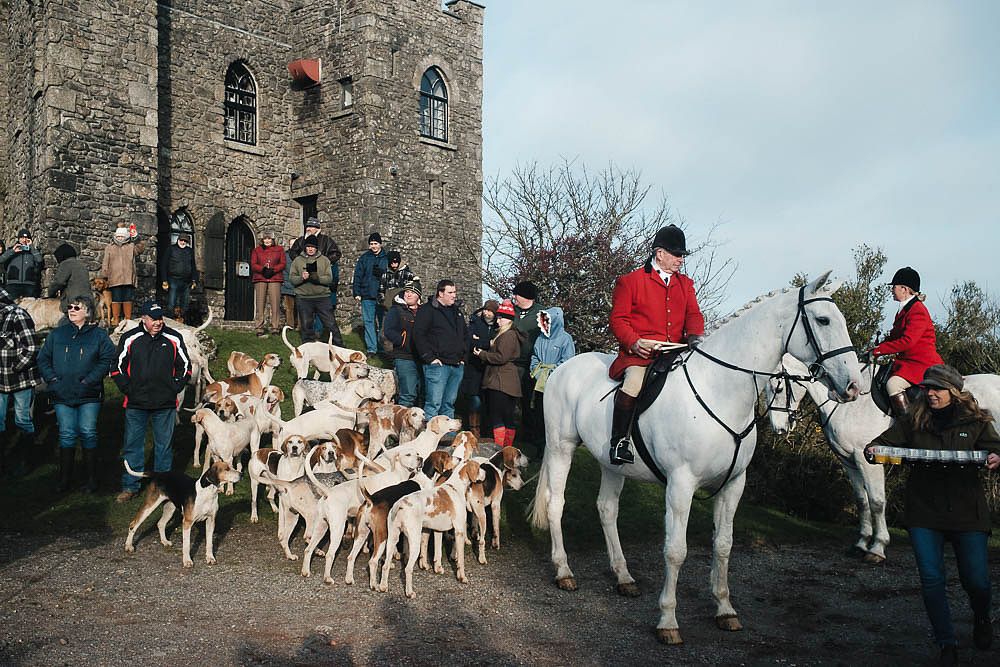
Boxing Day: Observations From a Hunt Meeting
I went to photograph the Boxing Day hunt meeting knowing it exists within a wider and increasingly contested conversation. For some, these gatherings are deeply familiar — part of the rural calendar and social fabric. For others, they represent something that should no longer have a place in modern society. I was conscious of that tension before I arrived, and it stayed with me throughout the day. My intention wasn’t to take a position, nor to try and resolve the arguments that surround trail hunting. I wanted to observe. To document what a hunt meeting looks like today, in the context of the scrutiny and controversy that now surrounds it.
A Practice in Question
Trail hunting came into existence following the Hunting Act 2004, which made hunting wild mammals with dogs illegal in England and Wales. In theory, hounds follow a pre-laid scent rather than a live animal. Those who support trail hunting often speak about legality, tradition, land management, and the continuation of rural skills and horsemanship. At the same time, I’m aware of the criticism. Animal welfare organisations and campaigners argue that trail hunting can be difficult to regulate and that it may, at times, be used to disguise illegal activity. This concern has led to renewed calls for trail hunting itself to be banned, not just reformed. These opposing views form the backdrop to every hunt meeting now. Even when unspoken, they are present.
What I Saw
On the ground, the meeting felt layered. Riders arrived early, horses carefully prepared, hounds alert and impatient. Boxing Day carries its own significance — it’s one of the most visible days in the hunting calendar, drawing not only participants but also spectators, critics, and members of the public who might otherwise never encounter a hunt at all. What struck me was the range of reasons people gave for being there. Some spoke about heritage and continuity, others about sport or community, others simply about marking the day in a familiar way. At the same time, there was an awareness — sometimes subtle, sometimes explicit — that not everyone present viewed the event in the same light. Support and opposition existed side by side, even when they occupied different physical spaces.
Photographing Without Taking Sides
As a documentary photographer, I don’t see my role as defending or condemning. I’m interested in recording what is happening, and what it feels like to be there, at this point in time. Rather than focusing on symbols or slogans, I found myself drawn to moments: small interactions, expressions, gestures, and details that hinted at something larger. The images reflect pride, routine, uncertainty, and contradiction — often within the same frame. If there is a theme running through the work, it’s that this is a tradition under pressure, existing in a state of transition. The confidence of long-established rituals sits alongside the knowledge that their future is being actively questioned.
An Unfinished Debate
Whether trail hunting should continue, be further regulated, or be banned altogether is still being debated — in Parliament, in courts, and in public spaces like this one. It’s not a debate with a simple resolution, and it’s unlikely to disappear any time soon. This work doesn’t attempt to answer those questions. It documents a moment where history, legislation, protest, and identity intersected on a cold Boxing Day morning. My hope is that the photographs allow space for the viewer to reflect, rather than telling them what to think. Sometimes, simply looking closely is enough to understand how complex an issue really is.